Blog • July 27, 2026
Ingress Got You This Far — A Field Guide to Gateway API & HTTPRoute
Why platform teams are re-routing north-south traffic through the Kubernetes Gateway API, what HTTPRoute changes on the ground, and how to migrate without a big-bang rewrite.
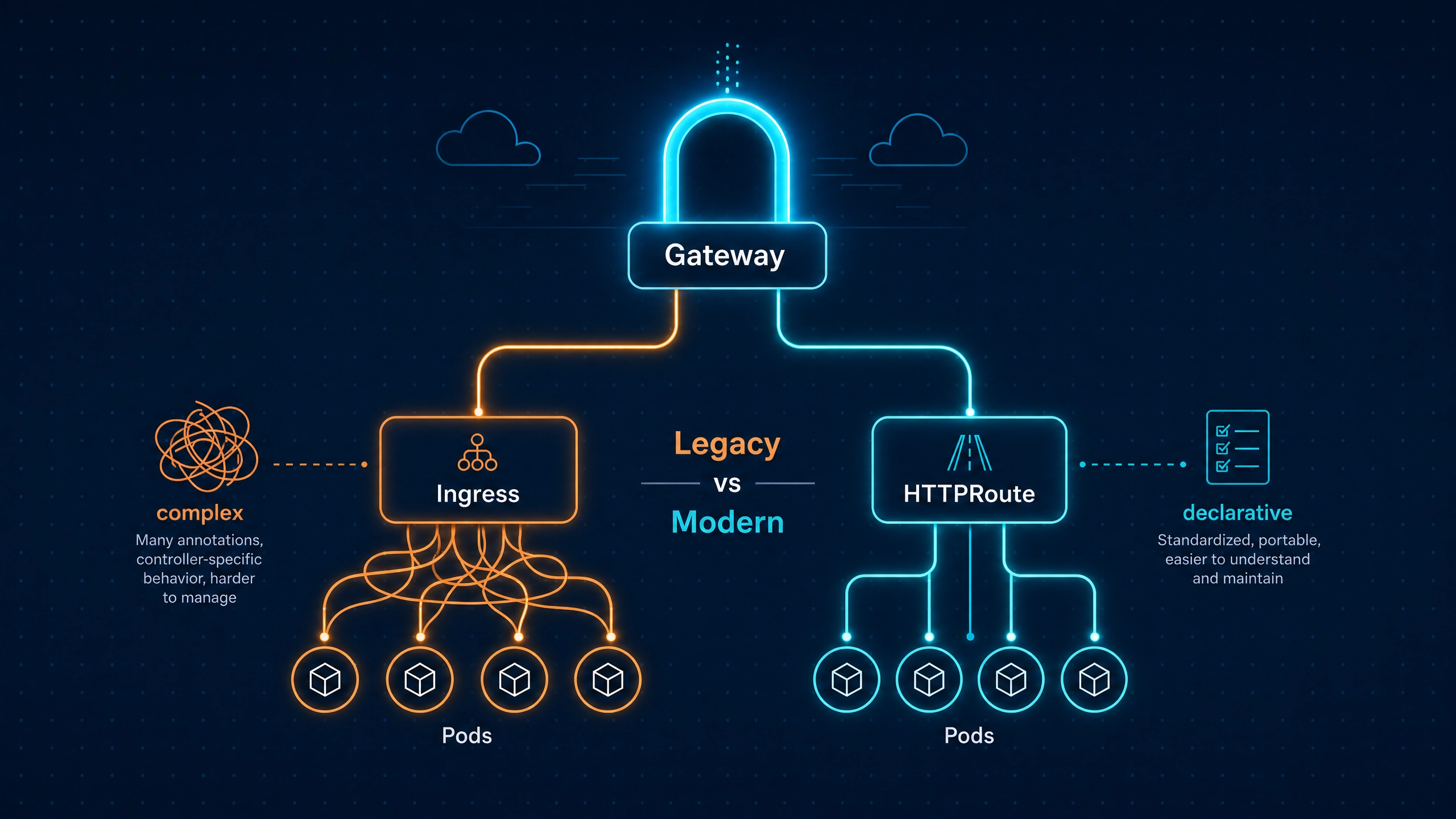
The Kubernetes Ingress resource has served as the standard way to manage external traffic for years. But as platforms have evolved and use cases have become more complex, the Kubernetes community has developed a more powerful and flexible successor: the Gateway API with its HTTPRoute resource.
This guide walks through why platform teams are making the move, what changes in practice, the pieces that make up an HTTPRoute, and how to execute the migration strategically — with our help, if you want it — without a disruptive big-bang rewrite.
The Fundamental Shift
Why Ingress is just the first chapter
Ingress is simple. A single resource type, a few standard annotations, and your traffic is routed. That simplicity works for basic cases.
But when you layer on:
- Multiple gateway implementations (NGINX, Envoy, cloud load balancers, service meshes)
- Traffic splitting and canary rollouts
- Cross-namespace routing with governance
- Standardization across teams
...you quickly hit the limits of Ingress. Each controller interprets annotations differently. Vendor-specific behavior bleeds through. There's no standard way to say "split 10% of traffic here" or "grant cross-namespace access explicitly."
Gateway API is built for that world. It's designed from the ground up to be vendor-neutral, composable, and auditable. Not a replacement for Ingress overnight, but the foundation for what platform teams actually need to build.
Meet the HTTPRoute
The shape is the same everywhere
An HTTPRoute is how you define HTTP/HTTPS routing in Gateway API. It's what Ingress was trying to be, but without the annotation chaos.
apiVersion: gateway.networking.k8s.io/v1kind: HTTPRoutemetadata: name: payments-apispec: parentRefs: - name: shared-external-gateway hostnames: - payments.example.com rules: - matches: - path: type: PathPrefix value: /api/v1 backendRefs: - name: payment-service port: 8080
The key difference: the shape is stable across implementations. Whether your Gateway is backed by Envoy, NGINX's Gateway Fabric, a cloud load balancer, or a service mesh, this HTTPRoute behaves the same way.
No annotations. No vendor-specific quirks. Just a clear, declarative specification of what traffic goes where.
The Components of an HTTPRoute
What each block is actually doing
An HTTPRoute reads top to bottom like a sentence: this route, attached to that Gateway, for these hosts, matching this traffic, goes to that backend. Here's what each piece controls:
- parentRefs: Declares which Gateway (or Gateways) this route attaches to. This is the handshake — a route does nothing until a Gateway accepts it. A single route can even attach to multiple Gateways for multi-cluster or multi-environment setups.
- hostnames: The set of hostnames this route answers for. Optional, but in shared-Gateway setups it's what lets a dozen teams safely attach routes to the same Gateway without one team's rule swallowing another's traffic.
- rules: The heart of the route. Each rule is a matches + filters + backendRefs triplet:
- matches — the conditions that select traffic: path (Exact, PathPrefix, RegularExpression), HTTP method, headers, or query params. A request only hits this rule if it satisfies a match block.
- filters — optional in-flight transformations: header modification, request/response redirects, URL rewrites, or traffic mirroring. This is where most of the vendor-specific "annotation magic" from Ingress now lives, but expressed as a portable, typed field instead of a free-text string.
- backendRefs — where matching traffic actually goes, including the weight field that powers traffic splitting (Sheet 04).
- ReferenceGrant (a companion resource, not a field on HTTPRoute itself): Lives in the target namespace and explicitly authorizes a route in another namespace to reference resources there. Covered in full in Sheet 05.
Put together, these components are why HTTPRoute scales past what Ingress annotations could ever cleanly support: routing logic, traffic shaping, and cross-team trust are each their own explicit, typed field — not overloaded into a single annotation block that only one controller understands.
Traffic Splitting and Canary Deployments
Same shape, every implementation
Canary rollouts—splitting traffic between versions to validate before full rollout—are a core pattern in modern deployments. With Ingress, you need controller-specific logic, sidecar configuration, or external tooling. With HTTPRoute, it's built in.
rules:- backendRefs: - name: payments-v1 port: 8080 weight: 90 - name: payments-v2 port: 8080 weight: 10
Because the weight lives on backendRefs directly, the same manifest works whether the Gateway is backed by Envoy, NGINX's Gateway Fabric, a cloud load balancer, or a service mesh's Gateway API implementation.
Move the rollout percentage, watch error rates, move it again — no controller-specific canary annotation to look up, no behavior that silently changes when you switch vendors.
Cross-Namespace Routing
Trust that's explicit, not implicit
With Ingress, cross-namespace wiring is either impossible cleanly or entirely dependent on which controller you happen to run. Gateway API makes it a first-class, auditable concept.
By default, a Gateway won't route to—or accept routes from—a different namespace, even if nothing technically stops it. To open that door, someone in the target namespace creates a ReferenceGrant: an explicit statement that "routes from namespace X are allowed to reference resources in namespace Y."
No grant, no traffic. It's a small resource, but it turns cross-team routing from an implicit assumption into something you can grep for in a Git repo.
Gateway (ns: infra-gateway) ↓ HTTPRoute (ns: payments) [ReferenceGrant ✓] HTTPRoute (ns: analytics) [ReferenceGrant ✓]
This is what makes a shared Gateway safe to offer as a platform product. One Gateway, provisioned and paid for once, can legitimately serve a dozen application teams—each attaching their own HTTPRoute, each requiring an explicit grant to do so, each fully isolated from the others' routing mistakes.
Migration Runbook
You don't need a big-bang rewrite
Ingress and Gateway API resources can run side by side in the same cluster. That's the whole point—it turns migration into a phased rollout instead of a cutover weekend.
Phase 01: Assessment
Understand what you're actually running before you touch it.
- Inventory every existing Ingress resource
- Map annotation dependencies per controller
- Audit TLS certificate sourcing
- Chart real traffic patterns per route
Phase 02: Migration
Stand up the new path without removing the old one yet.
- Deploy a Gateway API implementation
- Convert routes namespace by namespace
- Run Ingress and HTTPRoute in parallel
- Validate against production traffic
Phase 03: Standardization
Make the new pattern the easy, default path.
- Template HTTPRoute into Helm charts
- Wire into existing GitOps pipelines
- Offer shared Gateways as a platform product
- Enable self-service for app teams
Helm Integration
HTTPRoute as just another templated manifest
Once HTTPRoute is in your chart, it behaves exactly like every other resource you already manage with GitOps: parameterized per environment, reviewed in a pull request, diffed cleanly by your pipeline.
apiVersion: gateway.networking.k8s.io/v1kind: HTTPRoutemetadata: name: {{ include "payment-service.fullname" . }}spec: parentRefs: - name: shared-external-gateway namespace: infra-gateway hostnames: - payments.example.com rules: - matches: - path: type: PathPrefix value: / backendRefs: - name: payment-service port: 8080
The parentRefs block is the seam worth templating carefully—point it at a different shared Gateway per environment via values.yaml, and the same chart promotes cleanly from staging to production without anyone hand-editing routing config along the way.
How We Can Help You Migrate
You don't have to run this phased rollout alone
The runbook in Sheet 06 is one most teams can run in-house. Where it slows down isn't the YAML — it's the judgment calls: which annotations map cleanly to which filters, which routes are safe to move first, how to prove parity before cutting traffic over. We plug in at exactly those points:
- Assessment — inventory your Ingress objects, map annotations to HTTPRoute filters, flag anything that won't translate one-to-one.
- Migration — convert routes namespace by namespace alongside your team, get ReferenceGrants right the first time, validate against production traffic before each old Ingress object comes down.
- Standardization — template HTTPRoute into your existing Helm charts and GitOps pipelines so new routes are self-service, not a platform ticket.
Engage us for one phase or all three — the target is your highest-value routes running cleanly on Gateway API, on your timeline.
Field Notes
Questions platform teams actually ask
Q: Do we have to migrate everything at once?
A: No. Ingress and Gateway API resources coexist in the same cluster, so most teams move their noisiest or highest-value routes first, validate against real traffic, then wind the old Ingress objects down namespace by namespace.
Q: Which controllers actually support Gateway API?
A: Most major ingress controllers, cloud load balancers, and service meshes now ship a Gateway API implementation alongside—or in place of—their Ingress controller. Conformance and feature coverage still varies, so it's worth checking your specific vendor's current status before committing to a migration timeline.
Q: What happens to annotations we rely on today?
A: Vendor-specific behavior moves into Gateway API's extension points—filters and attached policies—rather than free-text annotations. Plan to translate that behavior deliberately during the migration phase rather than assuming a one-to-one copy-paste.
Key Takeaways
- Gateway API is the modern standard for routing in Kubernetes—more composable, more portable, and vendor-neutral.
- HTTPRoute eliminates annotation chaos by providing a stable, declarative shape that works the same way across every implementation.
- HTTPRoute's components — parentRefs, hostnames, matches, filters, and backendRefs — each replace a slice of what used to be overloaded annotations, making routing logic explicit and typed instead of vendor-specific.
- Traffic splitting and canary deployments are first-class citizens in HTTPRoute, with no special annotations or controller-specific config needed.
- Cross-namespace routing becomes auditable through explicit ReferenceGrants, turning implicit trust into verifiable policy.
- Migration is phased, not a cutover—Ingress and Gateway API can coexist, letting you move routes at your own pace and validate against real traffic.
- HTTPRoute integrates cleanly into GitOps workflows—it's just another templated Kubernetes manifest, reviewable and diffable like everything else.
- You don't have to run the migration solo — assessment, hands-on conversion, and standardization support are available at whichever phase you need it.
Next Steps
If you're running Ingress today and wondering whether it's time to move:
- Start with assessment: Inventory your Ingress resources, understand your traffic patterns, and map out controller-specific annotations you rely on.
- Pick a Gateway API implementation: Most major controllers now support it. Validate that it works with your specific tooling.
- Migrate high-value routes first: Don't touch everything at once. Move your noisiest or most complex routes, run them in parallel with Ingress, and validate against production traffic.
- Templatize for your platform: Once you've proven the pattern, bake HTTPRoute into your Helm charts and offer shared Gateways as a platform product.
- Bring us in where it helps: Whether it's a one-time assessment or hands-on pairing through the whole rollout, we're glad to help you get there faster.
The future of Kubernetes routing is here. Moving to it doesn't have to be a big-bang rewrite — and you don't have to do it alone.