Blog • September 1, 2025
From Risk to Revenue: How IT Compliance Protects Businesses and Drives Growth
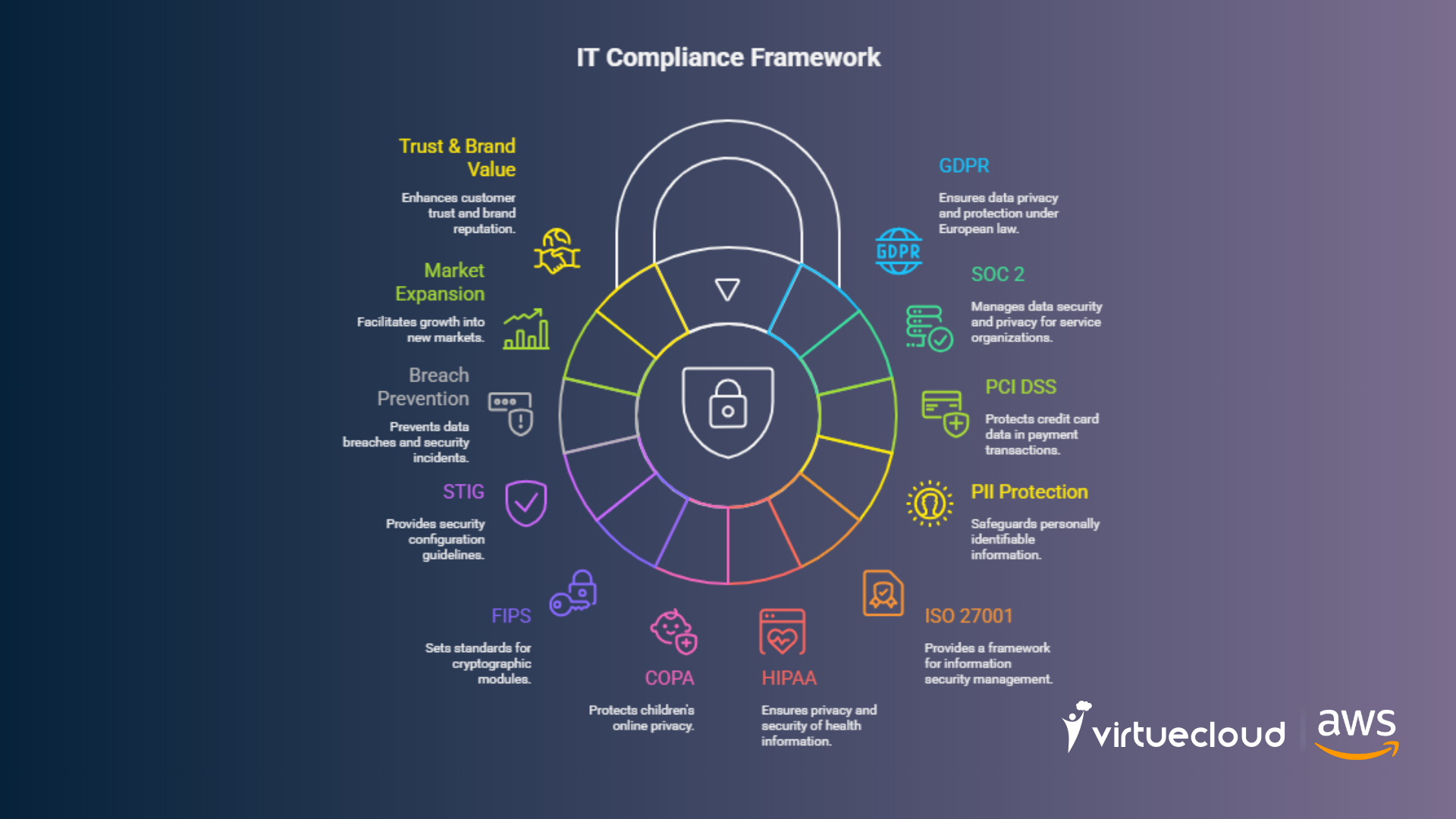
Introduction – Why Compliance Matters More Than Ever
In the last decade, the stakes for IT security have skyrocketed. A single breach can cost millions in direct damages and even more in lost reputation. From ransomware crippling hospitals to payment card leaks damaging global retail brands, data is now a core asset — and a core risk.
But here’s the twist: compliance isn’t just about avoiding penalties or satisfying auditors. It can be your ticket to bigger business opportunities. Large enterprises, regulated industries, and government contracts often demand strict adherence to security frameworks before they even consider a partnership.
This blog explores nine major compliance standards that dominate the IT industry — how they prevent breaches, why they matter to different sectors, and how they can give you a competitive edge.
The Business Case for Compliance
Let’s get one thing straight — compliance is not security itself; it’s the framework that ensures security practices are applied consistently. Think of it like a building code: it won’t stop storms, but it will make sure your building can withstand one.
The three main benefits:
- Breach Prevention: Strong policies, encryption, and access controls reduce attack surfaces.
- Market Expansion: Many industries only work with vendors who meet specific compliance standards.
- Trust & Brand Value: Customers are more likely to choose you if they know their data is safe.
Compliance Standards Deep Dive
1. GDPR – General Data Protection Regulation
- Region: European Union (applies globally if handling EU citizen data) Focus: Data privacy and protection rights
- How it prevents breaches: GDPR enforces principles like data minimization, encryption, and “privacy by design.” Even if a breach occurs, these measures ensure the stolen data is unreadable and limited in scope.
- Industry impact: Essential for e-commerce, SaaS, healthcare, and marketing companies with EU customers.
- Business growth example: A SaaS startup in the U.S. expanded into Europe only after becoming GDPR-compliant, unlocking €5M worth of enterprise contracts that previously required compliance proof.
- Risk if ignored: Fines up to €20M or 4% of annual global revenue, whichever is higher. In 2019, the French data protection authority, CNIL, fined Google €50 million for violating the General Data Protection Regulation (GDPR). The fine was issued due to Google's lack of transparency and insufficient information provided to users regarding how their data is used, particularly for personalized advertising. Specifically, CNIL found that Google failed to obtain valid consent for personalized ads and didn't provide clear and easily accessible information about data processing practices
In 2019, a major tech company was fined €50 million by a European data protection authority for failing to meet GDPR transparency and user consent requirements. The case highlighted the serious consequences of non-compliance, prompting many organizations to invest heavily in GDPR readiness to avoid fines and protect their brand reputation.
2. SOC 2 – Service Organization Control 2
- Region: Primarily North America, but globally recognized Focus: Secure handling of customer data
- How it prevents breaches: SOC 2 requires continuous monitoring, incident response plans, and access restrictions based on the “least privilege” principle.
- Industry impact: Critical for SaaS, cloud service providers, fintech, and data processors.
- Business growth example: A cloud provider closed a deal with a Fortune 500 client after completing SOC 2 certification because the client’s procurement policy mandated it.
- Risk if ignored: Loss of enterprise deals and partner trust — often a sales blocker in B2B SaaS.
A fast-growing compliance automation startup raised over $50 million in Series A funding, thanks in part to its focus on helping businesses achieve SOC 2 compliance quickly. The funding success highlights how critical SOC 2 has become—not just for security assurance, but also for gaining investor confidence and enabling business growth.
3. PCI DSS – Payment Card Industry Data Security Standard
- Region: Global Focus: Securing payment card transactions
- How it prevents breaches: Requires end-to-end encryption, firewalls, and network segmentation to ensure payment data never passes through insecure systems.
- Industry impact: Vital for retailers, e-commerce platforms, payment processors, and fintech apps.
- Business growth example: A retail chain expanded to online payments without compliance issues by integrating PCI-compliant gateways, avoiding $500K in potential fraud-related losses.
- Risk if ignored: Non-compliance can lead to loss of payment processing rights and heavy fines from card networks.
In the aftermath of a high-profile data breach in 2018, a major international airline pursued ISO 27001 certification to reassure stakeholders and clients about the strength of its data security practices.
4. PII Protection – Personally Identifiable Information
- Region: Global (varies by country) Focus: Safeguarding personal identifiers like names, IDs, emails, SSNs
- How it prevents breaches: Uses encryption, anonymization, and strict access control to ensure sensitive personal data can’t be exploited if stolen.
- Industry impact: Applies to all industries, but especially education, healthcare, finance, and government services.
- Business growth example: A digital health app gained investor confidence after proving its PII protection measures matched global best practices, leading to a successful Series A funding round.
In 2017, a major credit bureau suffered a massive breach that exposed sensitive data of 147 million people, leading to a $575 million settlement—one of the largest ever for a data incident. The breach highlighted the risks of weak PII protection.
In response, companies—especially in finance and healthcare—ramped up investments in encryption, data masking, and access controls. It also fueled growth in privacy tech, as businesses sought stronger safeguards to maintain trust and meet investor expectations.
5. ISO 27001 – International Standard for Information Security
- Region: Global Focus: Managing information security through a formal ISMS (Information Security Management System)
- How it prevents breaches: Establishes risk assessments, internal audits, and defined controls to reduce security gaps.
- Industry impact: A must-have for global B2B businesses, managed service providers, and tech exporters.
- Business growth example: A cybersecurity firm won a contract in Japan solely because its ISO 27001 certification was a client requirement.
In 2021, a leading cloud service provider achieved ISO 27001 certification across its core services, reinforcing its commitment to strong information security. This enabled deeper expansion into regulated sectors like healthcare and finance, where such certification is often a prerequisite.
For many SaaS and B2B tech firms, ISO 27001 is more than a compliance milestone—it’s essential for accessing high-value markets, particularly in regions like Europe and Asia where it's frequently required.
6. HIPAA – Health Insurance Portability and Accountability Act
- Region: United States Focus: Protecting sensitive patient health information
- How it prevents breaches: Mandates encryption, secure transmission, and patient consent before sharing data.
- Industry impact: Essential for hospitals, health tech startups, insurers, and telemedicine platforms.
- Business growth example: A telehealth company secured partnerships with top U.S. hospitals after demonstrating HIPAA compliance.
- Risk if ignored: Fines up to $1.5M per violation per year, plus severe brand damage.
In 2015, a major U.S. health insurer experienced a breach that exposed the records of nearly 79 million individuals, including sensitive data like medical IDs and Social Security numbers. The incident led to a $16 million HIPAA settlement—the largest ever at the time.
The case underscored the serious financial risks of non-compliance. Since then, HIPAA adherence has become a core selling point for health tech and telemedicine startups aiming to win contracts with hospitals, insurers, and enterprise healthcare providers.
7. COPA – Children’s Online Privacy Protection Act
- Region: United States Focus: Safeguarding children’s online data (under age 13)
- How it prevents breaches: Requires parental consent before collecting data and prohibits targeted marketing to minors.
- Industry impact: Key for educational tech, gaming, streaming platforms, and children’s content providers.
- Business growth example: An edtech platform expanded into U.S. school districts after achieving COPA compliance.
- Real Example: In 2019, Google and YouTube were fined $170 million by the U.S. Federal Trade Commission (FTC) for violating COPPA by illegally collecting personal data from children without parental consent to serve targeted ads. This became one of the largest COPPA enforcement actions in history.
Following increased regulatory scrutiny, major platforms shifted their strategies by implementing content labeling and restricting personalized ads on children’s content. For edtech, gaming, and streaming companies, demonstrating COPPA compliance has become a competitive advantage, enabling safer access to schools, family markets, and children’s app ecosystems.
Ignoring these regulations risks not only hefty fines but also loss of access to key distribution channels and parental trust—factors that can severely hinder business growth.
8. FIPS – Federal Information Processing Standards
- Region: United States (federal) Focus: Secure encryption and IT standards for federal systems
- How it prevents breaches: Ensures only NIST-approved cryptographic algorithms are used, reducing vulnerabilities in government-linked systems.
- Industry impact: Mandatory for federal contractors, defense suppliers, and high-security vendors.
- Business growth example: An IoT vendor became eligible for a $10M U.S. defense contract after meeting FIPS encryption standards.
- Real Example: In 2021, Microsoft Azure announced that several of its cloud services, including Azure Storage and Azure Disk Encryption, achieved FIPS 140-2 validation for cryptographic modules. This validation was critical for Azure to support U.S. federal agencies and defense contractors, enabling it to compete for high-security government workloads.
Achieving FIPS compliance is often essential for accessing federal contracts. Vendors in cloud, cybersecurity, and IoT who meet these standards can tap into lucrative markets like the Department of Defense and federal healthcare systems—off-limits to non-compliant providers.
Without FIPS compliance, vendors are barred from government contracts, losing access to one of the most stable and profitable client bases.
9. STIG – Security Technical Implementation Guides
- Region: United States (Defense) Focus: Secure system configuration standards
- How it prevents breaches: Eliminates unnecessary ports, services, and permissions — reducing attack surfaces in critical systems.
- Industry impact: Used in military, aerospace, and national security projects.
- Business growth example: A software firm entered the U.S. defense market after ensuring its product met STIG compliance.
All systems connected to certain federal defense networks must be STIG-compliant. For example, in 2020, a major Linux distribution released STIG profiles enabling contractors to meet security baselines and operate in classified environments.
STIG compliance is essential for accessing defense and aerospace sectors, opening doors to multi-billion-dollar contracts. Without it, providers are excluded from key government systems and projects, losing access to a valuable, long-term market.
Conclusion – Compliance as a Growth Strategy
Compliance isn’t a one-time checkbox — it’s a continuous process that makes your business more resilient, trustworthy, and competitive. In many industries, compliance is the gatekeeper to the biggest contracts.
If you treat it only as a legal obligation, you’ll spend money. If you treat it as a growth strategy, you’ll make money.